
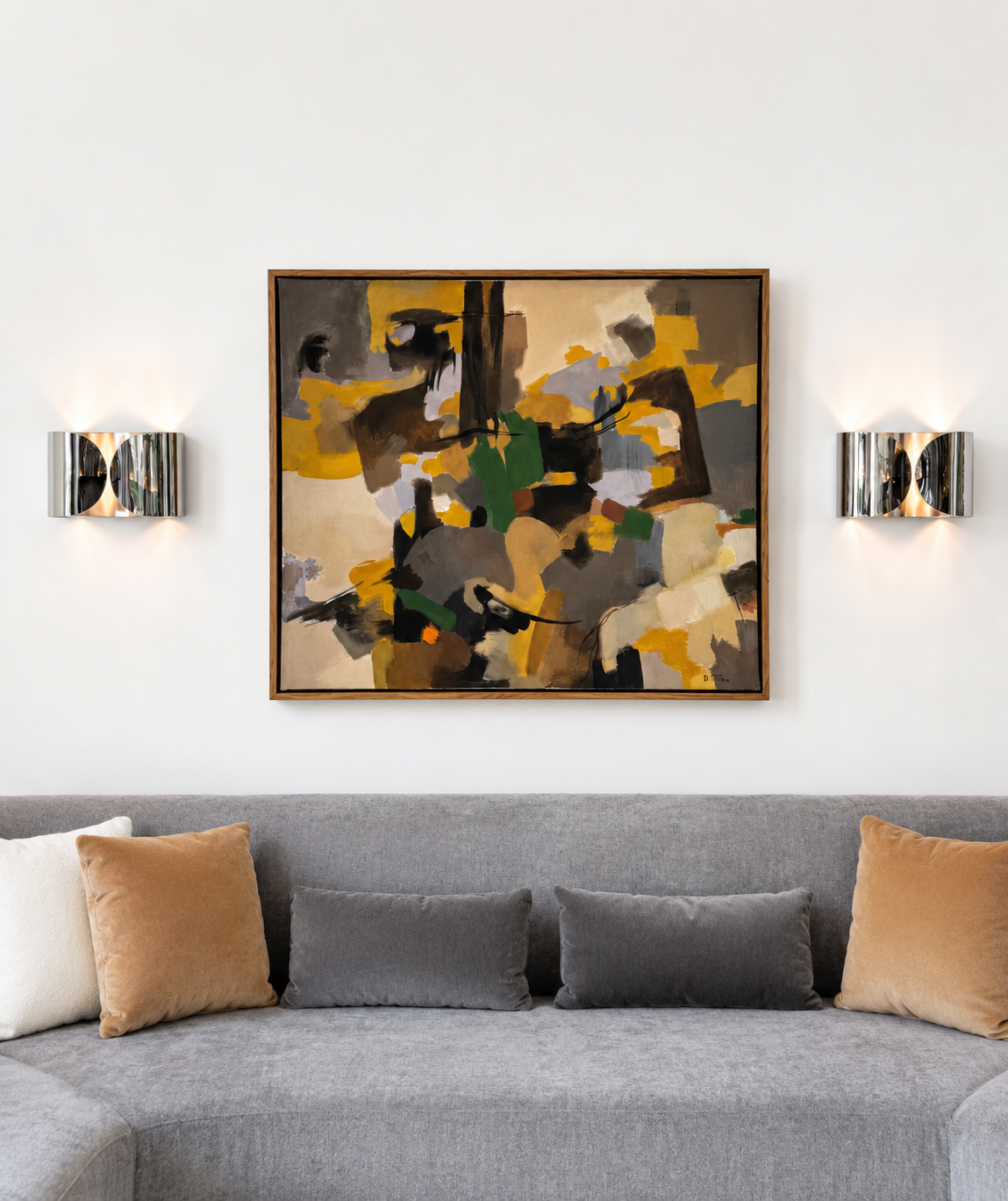
Curating artwork for seasoned collectors is often less about introducing them to contemporary art and more about finding something unexpected, an artist or work that adds another layer to a collection they have thoughtfully built over time.
For our clients’ sleek, Italian-inspired San Francisco pied-à-terre, we were searching for a painting that would complement the home’s refined, modern interiors while reflecting their preference for a more restrained palette. As experienced collectors with contemporary artwork throughout their other homes, they were drawn to something with both visual presence and an interesting story.
We found it in a painting by California modernist Don Totten.
Totten approached painting as what he called “the art of using color in space.” His semi-abstract compositions suggest landscape without describing it literally, allowing color, form, and gesture to create their own sense of depth and movement.
By the early 1960s, Totten's work was receiving significant institutional attention. Thomas W. Leavitt, the pioneering director of the Pasadena Art Museum, included him in a three-artist exhibition in 1960 and later, as director of the Santa Barbara Museum of Art, presented Totten in a solo exhibition in 1964. Totten had also studied with Stanton MacDonald-Wright, a founder of Synchromism, whose ideas about color would become an important influence on his work.
The painting we selected beautifully bridges abstraction and landscape. Its sophisticated palette of ochre, umber, charcoal, gray, and deep green brings warmth to the quiet interior without introducing the bright color our clients wished to avoid. Framed simply in wood and flanked by sculptural Italian sconces, it feels entirely at home in the space.
Totten's career was unexpectedly cut short by a devastating stroke, and much of his work remained out of public view for decades. Discovering this painting through Taylor Graham Gallery in New York made the acquisition feel even more special, an opportunity to bring the work of a compelling, under-recognized artist back into the conversation.
For us, that is one of the joys of curating: finding a work that belongs not only on a particular wall, but within the larger story of a client's collection.
Thoughtfully collected, and distinctly their own.